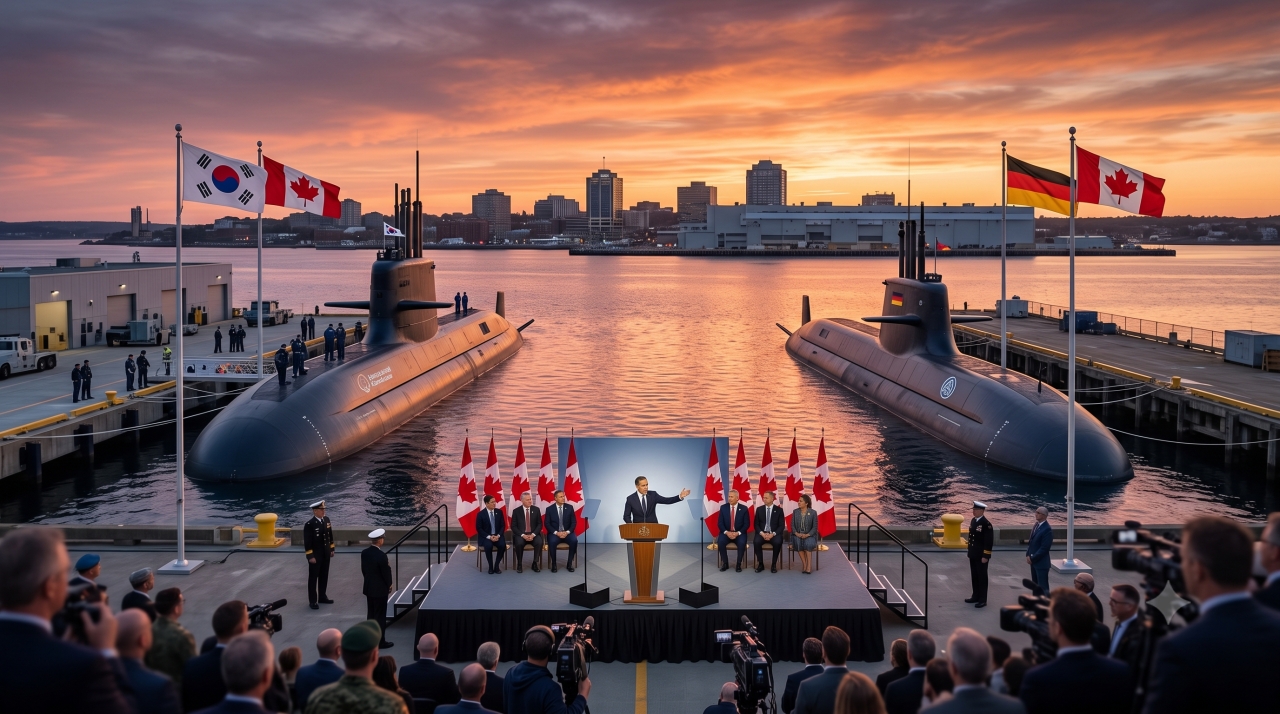
Core Momentum: With the announcement of the preferred bidder for Canada’s Next-Generation Submarine Project (CPSP)—valued at up to 60 trillion won, making it the largest single defense export project in South Korean history—imminent for the afternoon of July 6 (local time), South Korea’s competitive edge in technology and delivery schedule has created a neck-and-neck race against NATO’s alliance barriers.
📊 1. [Comprehensive Section 1: Cross-Verification of Core Figures & Facts]
According to public market data and comprehensive reports from major news outlets, the preferred bidder for the ‘Canadian Patrol Submarine Project (CPSP),’ which aims to acquire up to 12 diesel-electric submarines to replace the Canadian Navy’s aging Victoria-class fleet, is scheduled to be officially announced at 5:10 PM on July 6, local time (5:10 AM on July 7, KST). Canadian Prime Minister Mark Carney will personally announce the new measures in Halifax, Nova Scotia—a major eastern port city home to a massive naval base—just prior to his departure for the NATO Summit.
This massive project is estimated to be worth up to 60 trillion won (generating economic ripple effects of approximately 70 billion to 100 billion Canadian dollars), encompassing the pure construction costs of the submarines as well as 30 years of Maintenance, Repair, and Overhaul (MRO) and subsequent logistics support. The final shortlist has narrowed down to a two-way battle between South Korea’s joint team of Hanwha Ocean (042660) and HD Hyundai Heavy Industries (329180) against Germany’s ThyssenKrupp Marine Systems (TKMS). The South Korean government (officially stated by Presidential Chief of Staff Kang Hoon-sik) and sources close to the Canadian-led Defense Strategic Review Board (DSRB) currently evaluate the probability of winning and potential participation at a ’50-50′ dead heat, confirming an unpredictable and fierce competition up to the final moment.
🚀 2. [Comprehensive Section 2: In-Depth Data Analysis & Outlook]
The structured database mapping the core proposal specifications and qualitative variables submitted by both South Korea and Germany is as follows:
Bidding Models and Technological Comparison:
South Korea (Hanwha Ocean & HD Hyundai Heavy Industries Team): Proposed the 3,600-ton ‘Jang Yeong-sil class (KSS-III Batch-II)’ model, which features proven sea trials and operational track records. Equipped with cutting-edge technologies such as lithium-ion batteries and Air-Independent Propulsion (AIP) systems, its primary strengths lie in superior price competitiveness and a reliable on-time delivery record.
Germany (TKMS): Put forward the 2,800-ton ‘212CD’ model, currently under joint development with Norway. While leveraging its traditional position as a submarine powerhouse and emphasizing interoperability among NATO member states, it is distinguished by being a new design that lacks an actual operational track record.
Package Proposals and Local Economic Ripple Effects (Offsets):
South Korea’s Commitment: Pledged approximately 70 billion Canadian dollars in economic opportunities, 500,000 local jobs, and a contribution of 100 billion Canadian dollars to local GDP through 2044. Hanwha Group has already established solid industrial cooperation packages by partnering with over 80 Canadian companies and institutions.
Germany’s Commitment: Countered with a fierce proposal promising the creation of 650,000 jobs and an 86 billion Canadian dollar contribution to local GDP.
Key Variables Shifting the Final Balance:
While Germany’s TKMS has faced negative headwinds due to a recent hacking incident at its subsidiary, South Korea has secured a crucial macroeconomic card to offset the disadvantage of not being a NATO member. This follows emerging discussions regarding South Korea’s potential participation in the Canadian-led ‘Global Defense Bank (DSRB)’ (with a reported 50-50 probability of joining).
Domestic Industrial Impact Upon Success:
Although detailed negotiations following the designation of a preferred bidder can take several years before final contract signing, winning the bid would break the record for the largest single defense export since the founding of South Korea due to the project’s single-prime contracting nature.
In particular, securing this massive project would allow HD Hyundai Heavy Industries (329180) and Hanwha Ocean (042660) to fully elevate their naval ship portfolios for entering the North American and European markets, sparking an unprecedented valuation re-rating momentum in the global defense industry.
📝 Editor’s Comment (by K-STOCK Editor)
The Canadian CPSP project transcends a mere corporate bidding war; it represents a major watershed moment that will determine whether K-Defense can successfully penetrate the internal strategic asset supply chains of the ‘Five Eyes’—the western world’s most robust intelligence and military alliance—and core G7 nations. Initial market assessments favored Germany’s TKMS, backed by standard NATO interoperability. However, the South Korean team has successfully leveled the playing field through concrete construction data, overwhelming schedule reduction capabilities, lithium-ion battery technology, and a sophisticated industrial cooperation package unifying over 80 local enterprises. From a business perspective, this execution is highly commendable.
Crucially, the recent cybersecurity (hacking) issues surrounding the German side, coupled with South Korea’s discussions to join the Global Defense Bank (DSRB), serve as pivotal macroeconomic variables that alleviate the Canadian government’s concerns regarding the geopolitical and administrative risks of importing from a non-NATO nation. Given the strict ‘winner-takes-all’ nature of the project—where split orders are highly unlikely due to the integration requirements of MRO frameworks—the long-term valuation re-rating for the actual operating entities, particularly HD Hyundai Heavy Industries (329180) and Hanwha Ocean, will swing by tens of trillions of won depending on the outcome. Investors should rationally decouple the immediate milestone of securing preferred bidder status from the long-term execution risks associated with the multi-year negotiation process.
📢 Disclaimer & Source Notice
Source: This content has been uniquely reconstructed as an edited analytical work by completely dismantling the sentence structures and cross-analyzing publicly available corporate facts and official market data.
Investment Risk Warning: This material is provided solely for informational and linguistic reference purposes. Under no circumstances does it constitute financial advice or a recommendation to buy or sell specific stocks. All investment decisions and financial responsibilities rest entirely with the individual investor.
Contact: For compliance inquiries or copyright-related requests, please contact ksb220805@gmail.com.
🔥 Bulls vs Bears, drop your analysis in the comments!